
After Pet Loss: Why Memorials Belong on the Blockchain
After Pet Loss: Why Memorials Belong on the Blockchain
In my previous post, I shared the story of a cat named Marcus — and how the desire to preserve his memory eventually led me to this project.
When we lose a beloved pet, what usually remains are photos, notes, and message histories. We post something on social media, and it feels like the memory is preserved. But social platforms have two fundamental problems.
First, they are designed for communication, not for long-term remembrance. Posts get buried in feeds and become difficult to find years later.
Second, they are centralized. A company can shut down a service, change its policies, or remove old content. When that happens, the memories disappear along with the platform.
There are also dedicated pet memorial websites. However, these are niche services, and there is no real guarantee that they will still exist five or ten years from now.
Why blockchain at all?
I am an IT engineer by profession. I had never worked seriously with blockchain before, but I was familiar with it as an engineering concept. At some point, it occurred to me that blockchain might actually be a good fit for this problem.
A blockchain is a distributed network where data exists for as long as the network itself remains active. There is no single owner who can quietly delete content or rewrite the rules later.
In 2023–2024, the TON (The Open Network) ecosystem was actively developing, and it stood out for a few practical reasons:
- very low transaction fees;
- seamless access through the Telegram app.
Why NFTs?
NFTs are not “pictures for speculation.” At their core, they are simply smart contracts with a defined structure. Such a contract can store:
- attributes (for example, a pet’s name and life dates);
- a reference to an image;
- additional metadata.
Another important point is interoperability. NFTs are supported by wallets (Tonkeeper, MyTonWallet), marketplaces (Getgems), and public explorers (Tonviewer). This means the data can be accessed through many different platforms — not just a single website.
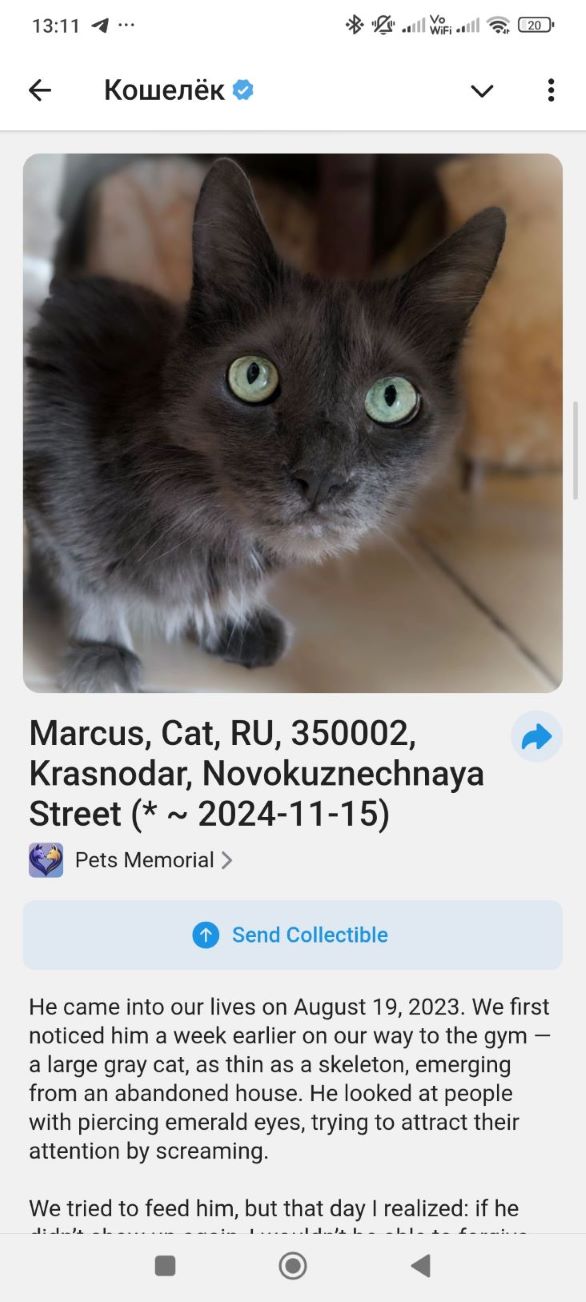
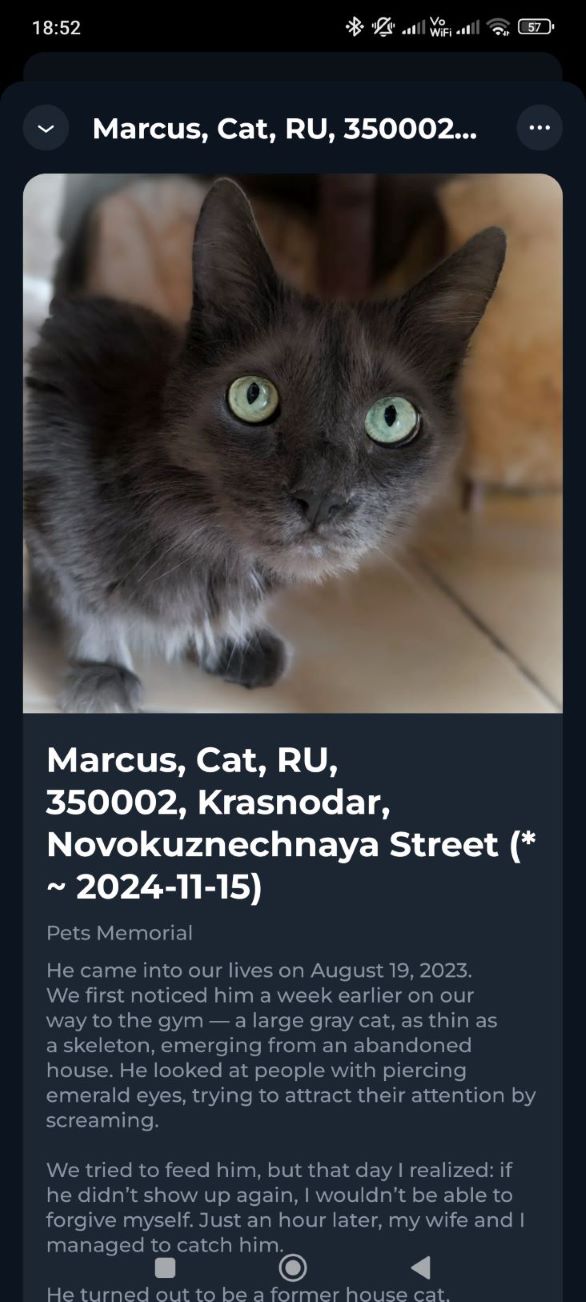
Memorial NFT displayed in different wallets
Initially, I considered using an existing solution, such as minting NFTs via Getgems. However, I quickly ran into several limitations:
- metadata is stored centrally on Getgems’ servers, with only links written to the blockchain;
- it is not possible to define a public collection with the specific fields I needed (life dates, memorial text, etc.);
- NFT data cannot be edited later — updating a photo or text is not supported.
At that point, it became clear that a custom smart contract was necessary.
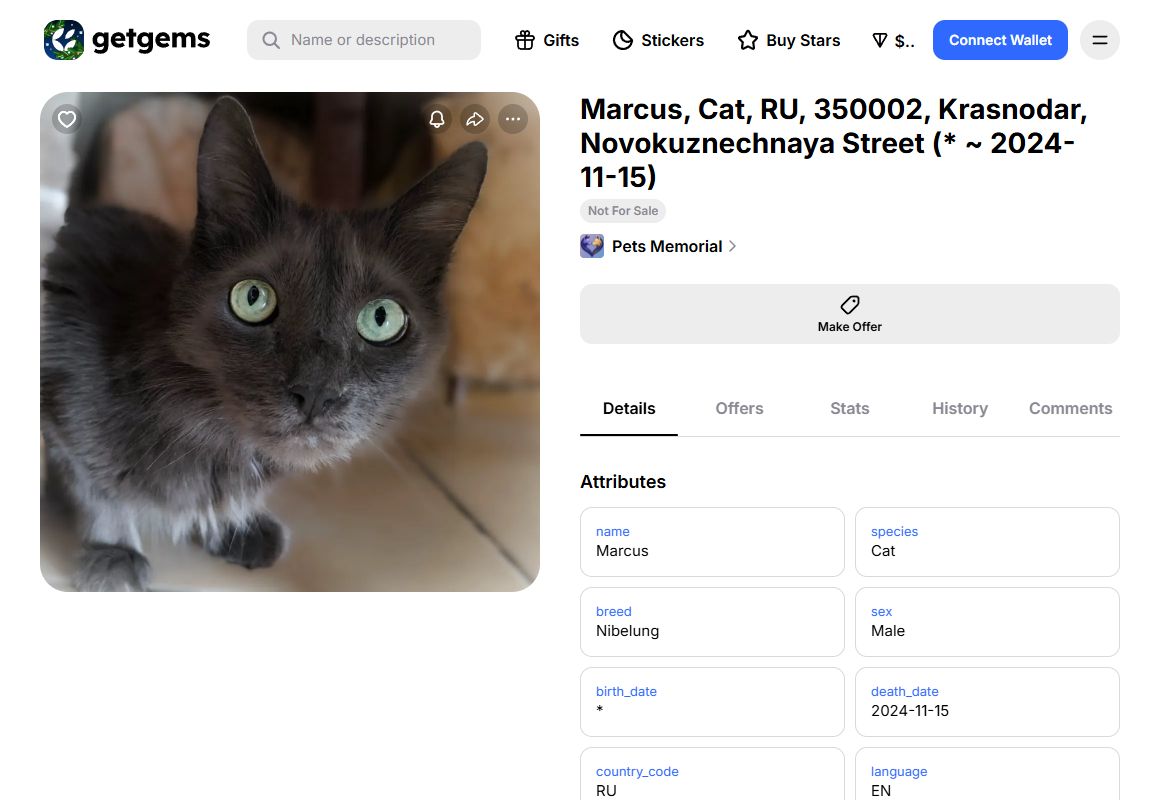 Memorial NFT view on Getgems
Building Pets Memorial
I invited a friend and former colleague to join me in implementing the project. We decided to create:
- a public NFT smart contract that stores as much data as possible directly on-chain;
- a unified data format (name, gender, life dates, memorial text);
- support for editing, so memories can evolve over time;
- a simple web interface for non-technical users.
Text is relatively easy to store on-chain. Images are not.
Small images (up to ~10 KB) can be stored directly. High-resolution photos are much larger, and storing them fully on-chain is impractical or prohibitively expensive.
We ended up with a hybrid approach:
- On-chain storage (up to ~10 KB) — suitable for thumbnails.
- External public services — users can link images hosted elsewhere.
- IPFS — decentralized media storage, accessed through a gateway that we currently maintain.
If a community forms around the project, we hope to promote native IPFS support within the TON ecosystem.
What the result looks like
All metadata is fully decentralized and stored on-chain. It will remain accessible for as long as the TON network exists.
Users can choose how images are stored:
- standard public hosting;
- a small on-chain thumbnail (fully decentralized);
- or IPFS via our gateway (decentralized, but availability depends on pinning).

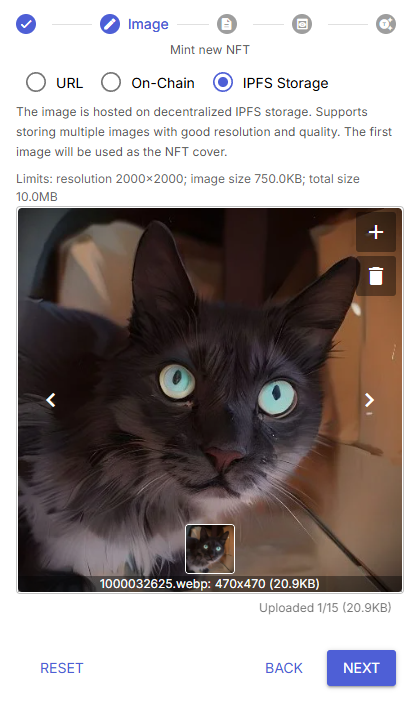

Creating a memorial NFT
Examples of memorial NFTs:
The smart contract is open-source and public. It is designed to support a shared collection of memorial NFTs with a common, well-defined structure.
This is a non-commercial project. We are not trying to build a startup or sell NFTs — we are trying to explore whether this approach can be meaningful for people who have experienced pet loss.